The evidence behind the narrative.
Primary research, institutional technical resources and bounded literature reviews. Links are organized for substantive reading—not to imply affiliation, endorsement or a product already being sold under this domain.
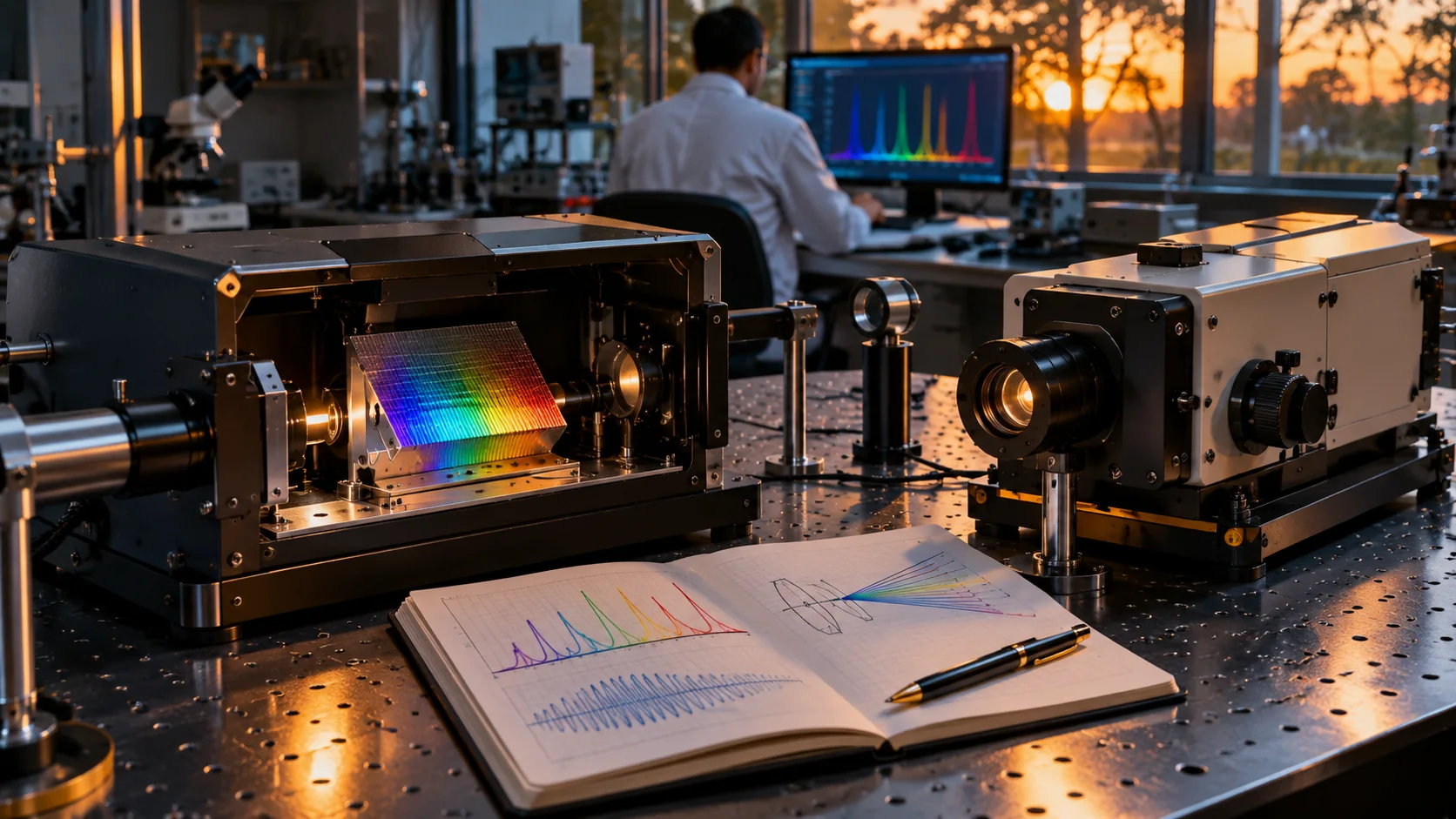
2025–2026 research context
Optical interconnects have become increasingly important in high-performance computing discussions because electrical data movement incurs energy and signal-integrity penalties. Researchers are studying compact integrated optical links, co-packaged architectures and novel chip-to-chip coupling, while industry must still solve operational and manufacturability constraints.
Beyond computing, NIST’s research demonstrates broad activity in photonic metrology and spectroscopy. NASA’s laser-communications work establishes that infrared data links have flown in actual missions, while also revealing the importance of pointing precision and atmospheric conditions.
Source library
- NIST — Photonics and Chip Scale Devices
NIST documents photonic integration in metrology, portable sensing and laser spectroscopy.
- Nature Electronics (2026) — Co-packaged optics for HPC and AI
Review of co-packaged optical interconnect challenges including thermal, packaging and standardization constraints.
- Nature Communications (2026) — All-distance silicon photonics
Peer-reviewed silicon-photonic coherent communications experiment with performance measurements; research-stage demonstration.
- Light: Science & Applications (2026) — Waveguide couplers
Technical survey of packaging coupling, optical interposers and chip-to-chip waveguide interfaces.
- Nature Photonics (2025) — 3D integrated photonic links
Demonstrated dense integration for energy-aware interchip data links.
- NASA — Deep Space Optical Communications
NASA documents infrared optical data links over interplanetary distances and the experiment’s completion.
- NASA — Laser Communications Overview
NASA describes the advantages and weather-related limitations of laser communications.
- Nature Photonics (2026) — Integrated photonics for continuous-variable quantum optics
Clark et al. review chip-scale sources, detectors and measurement of continuous-variable quantum optical states.
- Materials Today (2025) — Multispectral photonic camouflage
Review of wavelength-dependent signature control; not evidence for broadband, universal invisibility.
- Li, Singh & Sievenpiper (2018) — Metasurfaces and their applications
Review of metasurfaces for wavefront engineering, imaging, scattering control and related uses; discusses limitations such as bandwidth and geometry.
- USPTO — Federal trademark searching
General trademark-search guidance; no clearance determination for this domain.
Reading the evidence responsibly
Measurements reported for a laboratory chip, a single demonstrated link or a small proof-of-concept cannot automatically be scaled to enterprise systems. We distinguish experimental reports, formal reviews, government demonstrations and technology-market proposals. The presence of a scientific citation is not a claim that InvisiblePhotonics.com owns that technology.
Ongoing uncertainties
Active challenges include electro-optical energy budgets, optical assembly yield, interconnect repairability, wavelength-temperature sensitivity, environmental calibration, and quantum detector loss. Those constraints are part of the commercialization story, not footnotes to hide.