Optical I/O and interconnects
Light-guided pathways for high-bandwidth communication inside and between systems.
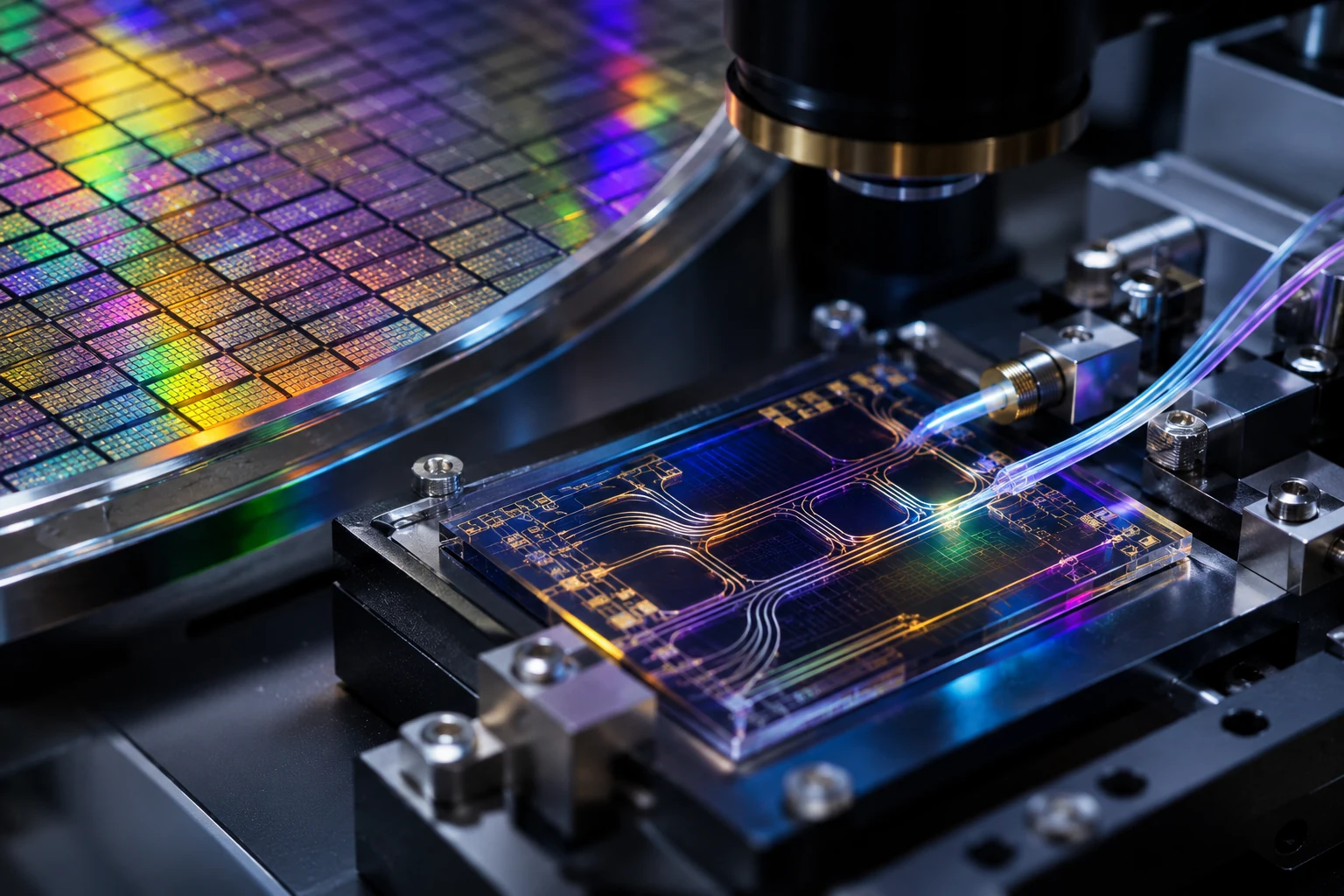
Why this frontier matters
The commercial case for photonic interconnects centers on energy, bandwidth density and signal integrity as data must move between accelerators, switches and memory-adjacent systems.
How the technology works
Transmitters encode information onto optical carriers using modulators; waveguides route the signals; couplers join dies, fibers and packages; photodetectors and electronic circuits recover the data. System-level energy includes lasers, drivers, temperature control and digital processing.
Where the technology fits
- Co-packaged optics near network switch ASICs
- Chip-to-chip optical I/O and photonic interposers
- High-density, wavelength-multiplexed links in AI infrastructure
Commercialization realities
Turning a technical function into a reliable product requires qualification, integration, operational evidence and an economic reason to adopt the system. A compelling physical mechanism is not, on its own, proof of market demand for a particular brand or domain.
- Thermal control, alignment and manufacturability are central engineering risks.
- Optics does not automatically beat copper at every reach or cost point.
- Optical engine yields and repairability influence production economics.
A low-loss on-chip waveguide does not guarantee an efficient deployed connection. Laser supply, alignment, fiber attach, drivers, thermal control, testing and serviceability determine practical optical I/O performance.
Selected technical reading
- Nature Electronics (2026) — Co-packaged optics for HPC and AI
Review of co-packaged optical interconnect challenges including thermal, packaging and standardization constraints.
- Nature Communications (2026) — All-distance silicon photonics
Peer-reviewed silicon-photonic coherent communications experiment with performance measurements; research-stage demonstration.
- Light: Science & Applications (2026) — Waveguide couplers
Technical survey of packaging coupling, optical interposers and chip-to-chip waveguide interfaces.
- Nature Photonics (2025) — 3D integrated photonic links
Demonstrated dense integration for energy-aware interchip data links.